An Dong Market Ho Chi Minh City: What to Buy, Prices and Bargaining
An Dong Market (Chợ An Đông) stands as Ho Chi Minh City's premier wholesale fashion destination and one of Vietnam's largest indoor markets. Located in the heart of District 5's bustling Chinatown, this massive marketplace serves as the fashion epicenter for wholesale buyers, retail shoppers, and cultural enthusiasts seeking authentic Vietnamese commercial experiences beyond the tourist-focused Ben Thanh Market.
An Dong Market Location & Transportation Guide
Address: No. 34-36, An Duong Vuong Street, Ward 9, District 5, Ho Chi Minh City
Operating Hours: 7:00 AM to 6:00 PM daily (some food stalls stay open later in the evening)
An Dong Market occupies a strategic position in Ho Chi Minh City's Chinatown district, making it easily accessible from both central tourist areas and residential neighborhoods. The market's location between District 1 and District 5 creates a natural bridge between tourist Ho Chi Minh City and authentic local commercial life.
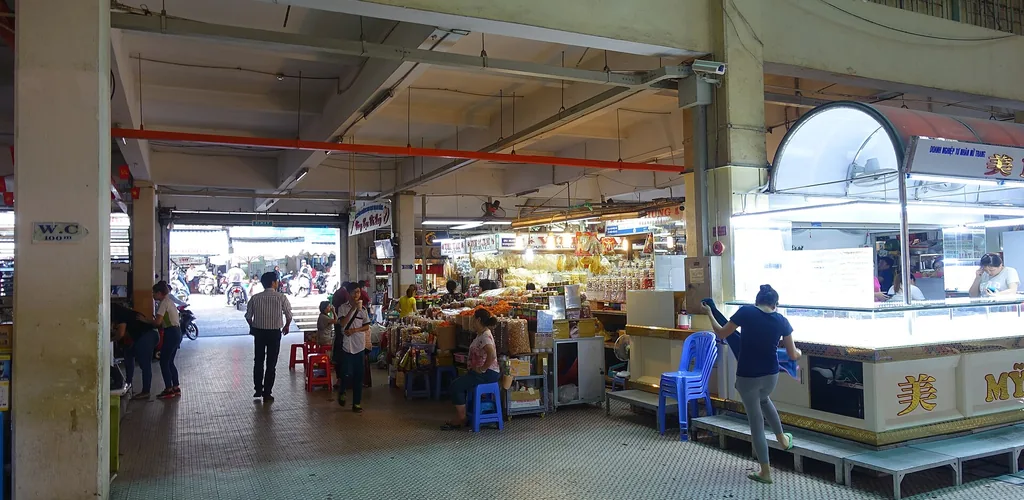
Under the concrete ceiling inside An Dong: stalls, a lit food counter and shoppers on the tiled floor. Photo: 胡志明市 安東市場 (31522738591).jpg — ixmatex wu, CC BY 2.0, via Wikimedia Commons
What to Buy at An Dong Market
An Dong is laid out by floor, and where you start depends on what you came for. The basement holds the food stalls, dried goods, jewellery and household plastics. The ground floor is the busiest level: fabric bolts, footwear, handbags and cosmetics. The floors above carry ready-to-wear clothing for adults and children, then ao dai material, tailoring services and handicrafts.
Fabric by the metre: This is what An Dong does that Ben Thanh does not. Silk, lace, brocade, cotton and chiffon are sold by the metre, and the stalls near the Hung Vuong Street entrance are the ones local tailors buy from. Most buyers at these counters are after material for an ao dai, a suit or formal wear, and several stalls on site will cut and sew a garment from fabric you choose. Ask about turnaround before you commit, because quoted times run from a few hours to two or three days.
Ready-to-wear clothing: Shirts, t-shirts, jeans, dresses, skirts, children's clothing and casual wear fill the middle floors. Stock comes from Vietnamese workshops and from China, Thailand, Japan and Korea, so quality and price vary from stall to stall. Because this market supplies clothing shops across southern Vietnam, the size and style range is wider than at a tourist-facing market and the stock turns over quickly.
Footwear, bags and accessories: Sandals, casual shoes, handbags, belts, wallets, jewellery and cosmetics sit mostly on the ground floor. Inspect stitching, soles and zips before you pay, because returns and exchanges are not part of how this market works.
Dried goods and snacks: Basement stalls sell cashews, dried fruit, dried seafood, chilli and packaged sweets, which makes An Dong a practical stop for edible souvenirs as well as clothes. The food court in the basement is where most shopping trips here break for a meal.
Wholesale against retail: An Dong is a working wholesale market that also serves retail shoppers; it is not a tourist market wearing a wholesale label. You can buy a single piece almost anywhere, but a single piece is priced at retail. Three or more of the same item, or a full carton, is what unlocks the wholesale rate, and that rate is quoted at the counter rather than printed. Buying one item still beats District 1 on base price; buying three or more is where the real gap opens, and two or three people shopping the same stalls together can reach wholesale terms between them.
An Dong Market Prices
An Dong prices are quoted stall by stall rather than from a published list, so the figures below are the range traders quote to walk-in customers and not a tariff. They are in Vietnamese Dong (VND). Prices verified October 2026.
Fabric by the metre - 80,000 to 300,000 VND: Cotton, linen and synthetic blends start around 80,000 VND a metre. Silk and lace, the material tailors and ao dai makers buy, run about 150,000 to 300,000 VND a metre, with premium silk above that.
Ready-to-wear clothing - 50,000 to 250,000 VND per piece: That is the walk-in retail band for shirts, jeans and skirts, and the better stock and formal wear run above it.
Bargaining at An Dong Market
The convention this site uses for Ben Thanh holds here as a starting point: open at around half the first quote and expect to settle near 60-70% of it. The Ben Thanh price guide has the worked example. Two things change that arithmetic at An Dong.
The room is smaller than at Ben Thanh: An Dong is an indoor, largely air-conditioned, wholesale-facing building, and guides written for this market put the opening offer at 60-70% of the asking price rather than the 40-50% a tourist counter expects. Stalls that display a marked price, and the smaller snack and dried-goods sellers, are often fixed, so 10-20% off a marked item is a more realistic ask than halving it.
Volume beats haggling: The stall's real business is bulk, so the cheapest route to a lower price is to ask what the wholesale rate is on three or more of the same item. That is a normal question here and it usually gets a second, lower number. Working a single piece down has less effect on the price than buying three pieces at wholesale.
The basics that still apply: Compare two or three stalls before committing, because dozens are selling the same stock. Bring cash in small VND notes, since most stalls take nothing else. Inspect stitching, zips and fabric weight before you pay, because returns are not expected. And expect much less English than at Ben Thanh, so let a calculator or a translation app carry the negotiation.
An Dong Market Compared with Ben Thanh Market
The difference is who the counter is built for. Ben Thanh is a tourist market: central, English-speaking, set up for one-off buyers, with prices inflated for visitors and hard bargaining expected on nearly every item. An Dong is a trade market: it supplies clothing and fabric shops across southern Vietnam, so the base price is closer to a wholesale price and a large part of the stock is sold in multiples.
For a traveller, that is the whole decision. Go to An Dong for fabric by the metre, for tailoring and for clothing in quantity. Go to Ben Thanh for a single souvenir, for coffee and lacquerware, or for a market you can walk to from District 1. The rest of the field - Binh Tay, Saigon Square and the malls - is covered in the other Saigon markets guide, the Ben Thanh vs Binh Tay comparison, and the Ben Thanh vs Saigon Square comparison.