Saigon Market Shopping Guide: How to Shop Ben Thanh, Gate by Gate
Ben Thanh Market has four doors, one on each of its four streets, and the standard guidebook line hands each door a different trade: textiles at one, coffee at another, crafts at a third, produce at the fourth. That mapping is not the market's. The operator publishes no per-gate trade list at all — its own system sorts the hall by trading area (khu vực) and block (Ô), not by door — and the guide pages that repeat the list do not agree with each other.
So this page does not sort the market by gate. It tells you what each of the four entrances physically is, what is actually settled about it, and then gives you the block number to ask for once you are inside, with the price you should be paying when you get there. That is the difference between walking the hall and walking to the thing you wanted: the numbering is the operator's, it runs to 1,392, and every stall is required to display its number on a board — which makes it the only navigation system in this building that is not somebody's opinion. The block-by-block detail is on our what's sold where at Ben Thanh page, and every price below comes from our Ben Thanh Market price guide — bargained figures, not the opening quote.
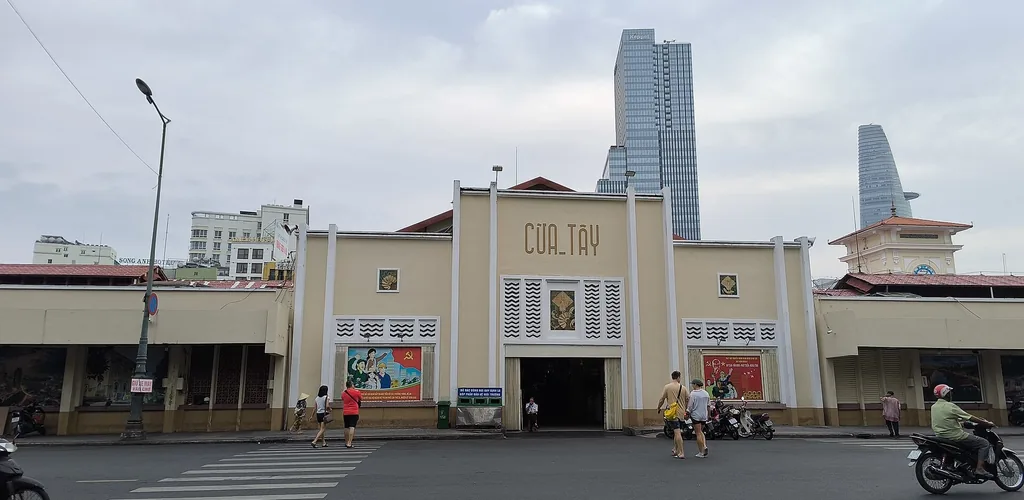
The Cửa Tây entrance, its pediment lettering and the city towers behind it — the door on Phan Chu Trinh, the metro side of the building. Photo: 2023-12-10 Bến Thành Market (Chợ Bến Thành) 01.jpg — 源義信, CC BY-SA 4.0, via Wikimedia Commons
The Four Gates at a Glance
| Gate | Street and landmark | What is settled about this frontage | What no one has published |
|---|---|---|---|
| South Gate (Cửa Nam) | Lê Lợi / Quách Thị Trang Square — the clock-tower side | The market's clock tower stands on the south gate, and this is the frontage that faces the open square in front of the building. | Which trade sits behind this door. The operator publishes no per-gate trade statement. |
| East Gate (Cửa Đông) | Phan Bội Châu | The street, and the fact that evening street stalls, when they are there, go up on this street. | Which trade sits behind this door. |
| West Gate (Cửa Tây) | Phan Chu Trinh | Metro Line 1's Bến Thành station exit 3 comes up on Phan Chu Trinh beside the market, near this gate. | Which trade sits behind this door. |
| North Gate (Cửa Bắc) | Lê Thánh Tôn — door number 9 | Fruit, fresh flowers and artificial flowers are sold along this frontage, and the operator's zoning names it as the market's flower-and-produce side. | What any of it costs: no verified produce price exists for this frontage. |
Why the Gates Are Not Four Shopping Districts
Plenty of pages will tell you one gate is for textiles and another for coffee. It is travel-guide copy, and the guides do not agree with one another. Five Vietnamese guide pages we read assign the four trades one way; a VnExpress feature and a VietnamNet article reprinted on the operator's own site assign them almost exactly the other way round. The two groups agree on a single gate, the North, and that one limb is corroborated by the operator's own zoning.
What the operator does publish is a zoning document. It divides the hall into four trading areas, Khu vực I to IV, splits them by odd and even stall numbers, and lists the goods block by block: fabrics and clothing in Areas I and II, coffee, dried goods, worship goods and fresh food in Area III, handicrafts and housewares in Area IV, with the eating area inside Area IV. What it does not publish is any map tying a door to an area — our own stall map says so explicitly, and it is the page to read if you want the full block-by-block breakdown.
That leaves the gates with a real but narrower job. They decide which street you arrive on, which landmark you meet, whether you come up out of the metro, which side the evening stalls appear on, and how much of the building you walk through before you reach your first stall. They do not decide what is sold. If you want a specific thing, ask for the Ô — say it "oh" — and the stall number, and the hall will take you there from any of the four doors.
South Gate (Cửa Nam): the Clock-Tower Door
What the gate is. The south frontage, on Lê Lợi beside Quách Thị Trang Square, with the market's clock tower above it. It is the side that faces the open square in front of the building — the city's own renovation zoning for the market block names that square as the south gate frontage.
What is settled. The tower and the square. Nothing about what is sold behind this door: the textile and clothing trade is listed by block, not by gate, so the block numbers below are what you actually shop by.
Where to walk instead. If fabric, a ready-made áo dài or a made-to-measure garment is the errand, the blocks are Ô 1A (stalls 1–627) and Ô 2A (2–520), which between them carry fabrics and cloth, clothing, children's goods, embroidered pictures and bedding; leather goods, bags and raincoats are in Ô 1B (629–665). Ask for "Ô 1A" rather than describing the dress you want.
What to pay. A ready-made áo dài is 300,000–800,000 VND. Fabric by the metre is 80,000–200,000, and the price tracks the weave, so feel the bolt before you commit. A genuine silk scarf starts at 300,000, against opening quotes of 600,000–900,000. A conical hat (nón lá) is 30,000–60,000.
The mistake to avoid. Treating a tailored áo dài as a same-day errand. Tailoring costs more than the ready-made band and takes a day or two, so an order placed the morning of your flight is how people end up paying the full ready-made price for something off the rack at the last minute. The second trap in this half is the "silk" that is not silk: genuine silk slides through your fingers and does not build up static, so if the scarf crackles when you rub it, keep walking.
East Gate (Cửa Đông): Phan Bội Châu
What the gate is. The east frontage, on Phan Bội Châu, one of the two streets flanking the building where the evening street stalls go up when they are there — the other is Phan Chu Trinh on the west.
What is settled. The street, and the fact that the evening street stalls go up on it when they are there. That is all: there is no published statement that any particular trade lives behind this door, and the guides that name one contradict each other.
Where to walk instead. Coffee, tea, confectionery, spices, dried and processed seafood, fish sauce and sugar are all in Ô 3A, the operator's food-technology block in Area III (odd numbers 743–1,145). Cosmetics and jewellery are in Ô 1C (667–741), back in Area I. Both are single aisles you can ask for by name.
What to pay. Vietnamese coffee in a 500 g bag of the standard packaged brands starts at 80,000 VND, against opening quotes of 150,000–300,000. Spices and dried goods start at 20,000 VND per 100 g, where pepper, star anise and turmeric are the reliable buys. Cosmetics have no benchmark we can stand behind, so compare two stalls in Ô 1C before you agree to anything.
The mistake to avoid. Applying the 80,000 VND coffee figure to premium beans. That price is for standard packaged brands such as Trung Nguyên; premium and weasel coffee are a different tier, and a stall quoting several times the standard-bag price for specialty beans is not necessarily cheating you. Most coffee stalls will let you taste before you buy — taste, then talk price.
West Gate (Cửa Tây): Phan Chu Trinh and the Metro
What the gate is. The west frontage, on Phan Chu Trinh. Metro Line 1's Bến Thành station exit 3 comes up on Phan Chu Trinh beside the market, near this gate, which makes it the natural door if you are arriving by metro rather than by taxi. Phan Chu Trinh is also the second of the two streets where evening stalls appear when they are there.
What is settled. The metro exit and the street. Which trade is behind the door is not published.
Where to walk instead. The lacquer, ceramics and rattan trade sits in Area IV's handicraft blocks: Ô 4A carries handicrafts, home appliances, porcelain and glassware, and Ô 4B carries handicrafts, rattan and bamboo, and plastic household goods. Both are in Area IV, the even-numbered half of the market (796–1,392). The sit-down eating area, which the operator lists as ẩm thực, is Ô 4C if you want to stop halfway — dishes and seating are on our food and dining guide.
What to pay. A small lacquerware box is 80,000–200,000 VND. A small souvenir such as a magnet or keyring is 20,000–50,000, the cheapest fixed-price purchases in the market. Ceramics and large lacquer pieces have no benchmark we can stand behind, so price the same piece in two or three stalls in Ô 4A before you commit.
If the lacquer and ceramics in this aisle leave you wanting the process rather than the shelf, the pottery studios and lacquer workshop in our artisan directory take visitors, with prices and contact details where each studio publishes them.
The mistake to avoid. Buying "mother-of-pearl inlay" on the strength of the pattern alone. Plastic passed off as inlay is the standard swap in this aisle: ask what the inlay is made of and what the backing is before you agree a number, and treat a price that looks like a bargain as the warning sign rather than the reason to buy.
North Gate (Cửa Bắc): the One Gate Everyone Agrees On
What the gate is. The north frontage, on Lê Thánh Tôn, and the operator's own designation for this entrance is door number 9 — the one gate number that is first-party rather than folklore.
What is settled. The goods. Fruit, fresh flowers and artificial flowers are sold along the Lê Thánh Tôn frontage, the operator's zoning names that frontage for exactly those three, and this is the single gate on which every guide page we read agrees. A December 2025 news item on the operator's own site goes further and places a fresh-flower trader in khu vực cửa Bắc, right at the door 9 entrance — Area III, beside the gate.
Where to walk. Two different places, depending on what you came for. The flowers and the fruit on the frontage are sold along the street rather than from a numbered indoor stall, so walk Lê Thánh Tôn itself first. For the fresh-food blocks inside, head to Area III — Ô 3C for fruit and vegetables, Ô 3D for staples, Ô 3E for fresh food including seafood, meat and poultry — or to Area IV's Ô 4E and Ô 4F.
What to pay. We do not print a produce price for this frontage, because no verified produce price for Ben Thanh exists and a made-up range is worse than none. The bargaining norms on our price guide are written for the souvenir, clothing and coffee aisles, where the opening quote is routinely two to three times the accepted price. Do not assume that gap applies to a bunch of flowers or a crate of fruit; where there is no benchmark, the previous stall is the only honest comparison.
The mistake to avoid. Arriving mid-morning and going straight inside. The market's rulebook allows fresh-food and eating stalls to open from 04:00 (Nội quy chợ, Điều 1), well before the rest of the building, and the produce side is at its busiest early, when the stalls are being set out. If the flowers are the point of the trip, walk the Lê Thánh Tôn frontage before the hall.
Shopping by Block: What You Came For, and What to Pay
The short version of the whole page, in the order a shopping list runs. Each block is the operator's; each price is the bargained figure from our price guide.
| You came for | Ask for | Fair price |
|---|---|---|
| Fabric, ready-made clothing, children's goods, bedding | Ô 1A (1–627) and Ô 2A (2–520), Areas I and II | Fabric 80,000–200,000 VND per metre; ready-made áo dài 300,000–800,000; silk scarf from 300,000 (opening 600,000–900,000); nón lá 30,000–60,000 |
| Leather goods, bags, raincoats | Ô 1B (629–665), Area I | No benchmark we can stand behind — compare two stalls |
| Cosmetics and jewellery | Ô 1C (667–741), Area I | No benchmark we can stand behind |
| Coffee, tea, confectionery, spices, dried goods, fish sauce | Ô 3A, Area III (743–1,145) | Coffee 500 g from 80,000 (opening 150,000–300,000); spices and dried goods from 20,000 per 100 g |
| Plated jewellery, hats, worship goods, kitchenware | Ô 3B, Area III | No benchmark we can stand behind |
| Handicrafts, porcelain, glassware | Ô 4A, Area IV (796–1,392) | Lacquerware box (small) 80,000–200,000; ceramics no benchmark |
| Rattan, bamboo, plastic housewares, small souvenirs | Ô 4B, Area IV | Small souvenir (magnet, keyring) 20,000–50,000 |
| Fruit, vegetables and fresh food | The Lê Thánh Tôn frontage; Ô 3C–3F and Ô 4E–4F inside | No verified produce price — none is printed here |
| A sit-down meal | Ô 4C, the eating area | Fixed price; see the food guide |
When to Go
The hall keeps a day window of 6:00 AM to 6:00 PM. Separately, and not contradicting it, the market's rulebook sets opening hours of 07:00 to 22:00, with fresh and cooked food stalls opening at 04:00; holidays are by separate notice (Nội quy chợ, Điều 1). The first is what visitors observe, the second is what the operator's instrument permits. The full picture is on our Ben Thanh opening hours page.
The evening street stalls, when they are there, go up on Phan Bội Châu and Phan Chu Trinh, the two streets flanking the building, and have no published closing time: the operator says its managed night area has been suspended since the pandemic, while the city's tourism listing still gives a 7:00 PM start. Check on the ground before planning an evening around it.
Within the day, the sequence matters as much as the door. Morning, roughly 6:00–10:00, is coolest and most flexible, and many vendors believe the first sale of the day brings luck, so they discount more readily to get it — that is the window for the North Gate frontage and the fresh blocks. Midday is the hottest and the busiest with tour groups, and the least flexible for bargaining. Late afternoon, 16:00–18:00, is when stalls would rather sell than pack up, so closing-time deals are common in the shopping aisles.
Eating Inside: the Food Hall Is Fixed-Price
The eating area is Ô 4C in the even-numbered Area IV, and along with the outer-ring stalls it is the part of the market where haggling does not apply: prices are set, not negotiated. The bands we hold are pho at 50,000–120,000 VND in the food hall, bánh mì at 25,000–40,000 and cà phê sữa đá at 25,000–40,000. Dishes, seating and the rest of the menu are on our food and dining guide.
Before You Walk In
- Cash, in VND. Cards are rarely accepted on souvenir stalls, and where they are, expect a small surcharge. ATMs sit inside the market and around its entrances.
- Open low, settle below the first quote. Our price guide works to a rule of thumb rather than a published norm: open at around 40% of the seller's first price and expect to settle near 50–60%. On a 300,000 VND scarf quote that means opening at about 120,000 and meeting around 150,000–180,000. No market, trade or government body publishes a bargaining norm for Ben Thanh, so treat the percentages as our working method, not as law.
- Not every stall bargains. The food hall is fixed-price, and some of the outer-ring stalls — often the staff in light-blue shirts — sell at set prices too. Bargaining belongs in the souvenir and clothing aisles.
- Note the stall number. Every stall must display its number on a board in the Management Board's standard format. A number is the market's own address for a pitch — useful if you want to come back, send someone else, or raise a problem later.
- Skip the brand claims. The "real" pearls, the "crocodile leather" and the brand-name anything are counterfeit at these prices. Genuine silk and quality lacquerware are fine; it is the luxury-label claims that are not.
If Ben Thanh is one stop of several, our other Saigon markets, compared covers the rest of the city, and the map and location guide places this building on the street grid before you set off. For what to buy once you are through the door, see what to buy at Ben Thanh; for evening stalls, see what runs after dark, in our dining guide.